Inside Navi Mumbai's Data Centre Mega-Cluster.
The Navi Mumbai corridor is one of India’s principal data centre clusters, anchored by Greater Mumbai’s carrier ecosystem and three submarine cable landing zones. The five sites assessed in this report energise between late 2028 and mid 2031, into hardware generations that step up two to three times in rack density between today and then. Whether each site can host those workloads, and at what mix, is a six-layer diligence question that integrates hardware roadmap timing, grid queue position, regulatory pathway, hazard envelopes, power topology, and cooling and water into a site-specific zoned-campus programme. AISIGINT runs that question on a multi-agent diligence platform tuned to AI workloads, integrating the six layers across a corridor’s parcels in days rather than the weeks conventional manual diligence takes. This report is the output of that platform run against five Navi Mumbai sites.
The delivery question is a linked set of power, land, water, fiber, permit, and schedule constraints.
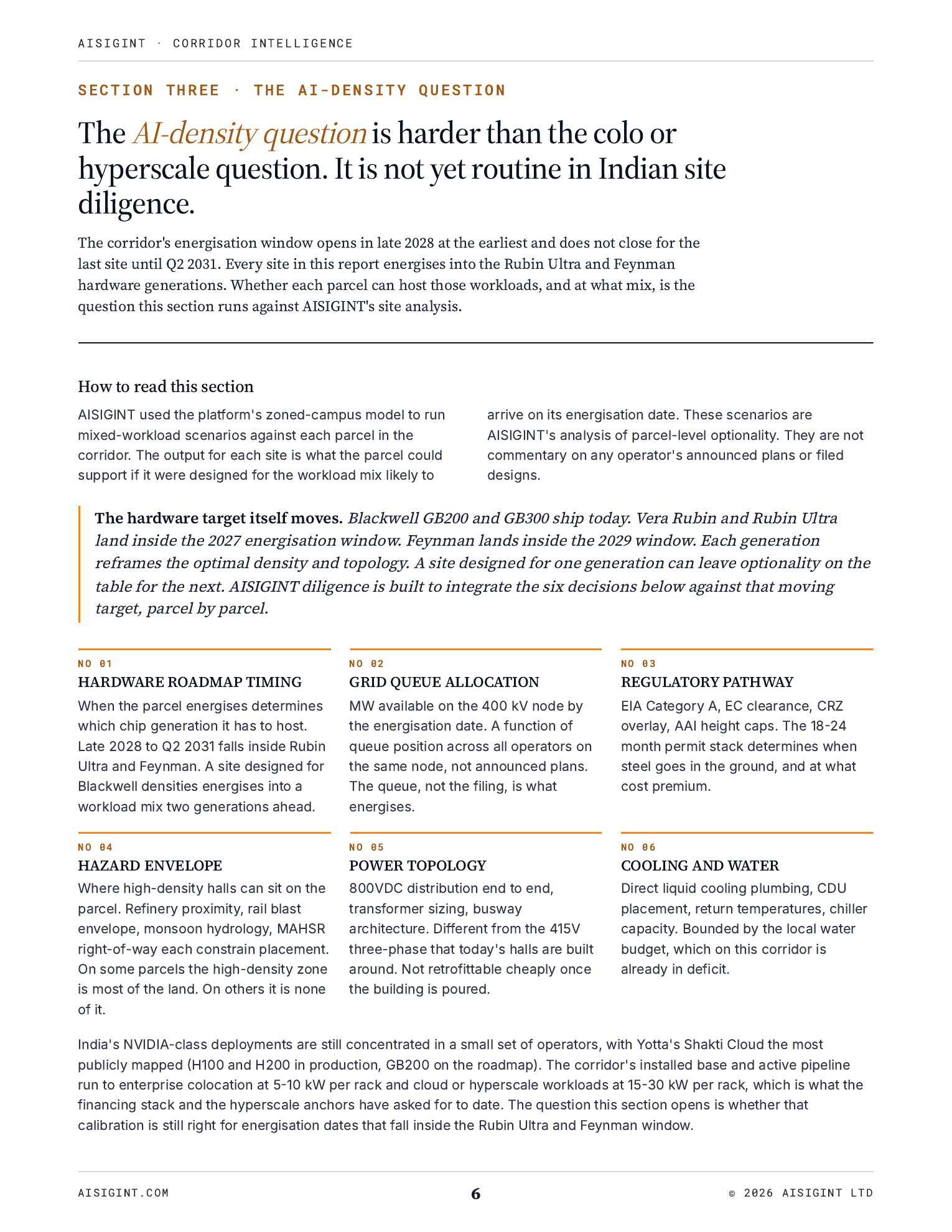
A viable AI datacenter site has to satisfy these constraints together. The report uses the framework below to show where the corridor is strong, constrained, or still needs validation.
Workload Timing
When capacity energizes determines which workload density, cooling architecture, and power design it may need to support.
Power Path
Corridor-level grid context, demand pressure, upgrade signals, and utility evidence determine what still needs site-specific confirmation.
Regulatory Pathway
Environmental, zoning, industrial authority, aviation, and local approval pathways affect when construction can begin and what risks remain unresolved.
Land and Hazard Envelope
Industrial land supply, access, flood exposure, nearby hazard context, and right-of-way constraints shape where AI-ready campuses may be practical.
Power Architecture
Target density, transformer sizing, distribution architecture, and phased energization assumptions need to be tested before design decisions harden.
Cooling and Water
Cooling design, water demand, resilience, and local source constraints determine whether the corridor can support the intended load mix.
The cheapest time to resolve power, cooling, and site-envelope assumptions is before land, permit, and utility commitments lock the design.
Evidence-led review across the constraints that decide time-to-power.
Collect corridor evidence
AISIGINT reviews corridor evidence across grid, land, water, permits, access, fiber, hazards, and demand activity.
Test cross-domain consistency
The analysis checks whether target MW, site envelope, water and cooling, fiber, permits, and schedule assumptions can all be true at the same time.
Identify validation work
The output flags the utility, legal, environmental, engineering, and field checks needed before relying on a site or corridor assumption.
Useful detail, not just the summary.
20 pages. Complimentary to qualified readers.
Available to operators, developers, site-selection teams, investors, lenders, advisors, and infrastructure partners active in datacenter delivery. Work email required.