NVIDIA's Vera Rubin platform went from roadmap to production at GTC 2026. Samples are shipping. General availability is H2 2026. OEM spec sheets from ASUS and Supermicro have filled in the infrastructure details: the NVL72 rack draws 227 kW (Max-P), requires liquid cooling with a 45C maximum inlet temperature, and needs reinforced flooring. The deployment picture now ranges from 2U server nodes (HGX NVL8) to 600 kW rack-scale systems (Rubin Ultra NVL576).
These numbers confirm something that's been building across the last four GPU generations: chip selection now determines building design.
For most of the DC industry's history, it didn't. A rack drew 10-15 kW in 2015, maybe 15-20 kW in 2018. Both ran on the same air cooling, the same power distribution, the same raised floor. You could swap in the next generation of servers without touching the building. Chip choice was a procurement decision, handled after the facility was designed.
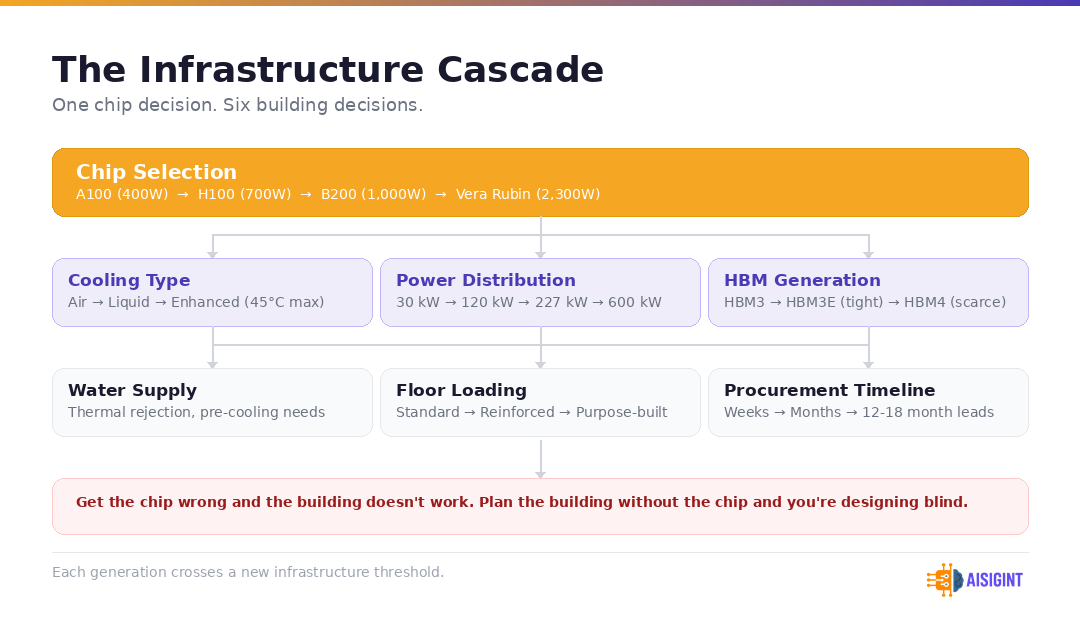
That broke. GPU TDP went from 400W (A100, 2020) to 700W (H100, 2022) to 1,000W (B200, 2024) to 2,300W (Vera Rubin, 2026). Each jump crossed a hard infrastructure threshold. At 700W, air cooling becomes marginal. At 1,000W, liquid cooling is required. At 2,300W, you need enhanced liquid cooling, potentially upgraded power distribution, and reinforced floors. These aren't incremental changes you absorb within an existing facility. They're different buildings.
The cascade
Every chip choice now triggers a chain of infrastructure decisions. Here are the current Vera Rubin deployment options, with the specs that don't make the keynotes:
| Config | Rack Power | Cooling | Floor Loading | Availability | |
|---|---|---|---|---|---|
| HGX Rubin NVL8 (8 GPUs, 2U) | TBD per node | Liquid required | Standard | H2 2026 | |
| Vera Rubin NVL72 (72 GPUs) | 227 kW (MaxP) / 187 kW (MaxQ) | Liquid, 45C max inlet | Reinforced | H2 2026 | |
| NVL144 CPX (144 GPUs) | ~260 kW | Liquid required | Reinforced | H2 2026 | |
| Rubin Ultra NVL576 (576 GPUs) | ~600 kW | Liquid, zero fans, 800VDC | Purpose-built | H2 2027 |
Chip TDP determines cooling type. Cooling type determines water supply and thermal rejection. Rack power determines electrical distribution. Rack density determines floor loading, which determines whether you need ground-floor or purpose-built facilities. HBM generation determines procurement timeline: H100 uses HBM3 (abundant, stable pricing), B200 uses HBM3E (tight supply, 40-50% price increases through 2025-26), and Vera Rubin uses HBM4 (sold out through 2026, limited production from SK Hynix and Samsung, Micron entering). Chip choice determines not just what you build, but when you can get the chips to fill it.
The 45C max inlet temperature on the NVL72 is a good example of a constraint that doesn't appear in any rack spec sheet but changes the building. In Mumbai, Chennai, and Gujarat, summer ambient temperatures push cooling water toward that threshold. Pre-cooling infrastructure adds capex and ongoing energy cost. That's a site-level decision driven entirely by the chip.
And the cost of getting this wrong compounds over time. Liquid cooling in a new build adds 15-25% over air cooling. Retrofitting an operating facility from air to liquid costs multiples of that, plus 12-18 months of downtime. A site designed for Blackwell at 120 kW can't handle Vera Rubin NVL72 at 227 kW without power and potentially structural upgrades. Each generation demands more from the building, and the building can't keep up without advance planning.
How this hits India's DC market
India's datacenter market is not one market. It's three, and each faces this cascade differently.
Hyperscaler-driven colocation is the largest segment. STT, NTT, NXTRA, AdaniConneX build facilities to hyperscaler specs. Microsoft ($3B committed), AWS ($8.3B in Maharashtra), Google and Adani ($15B joint investment over five years) tell the operator what to build. The operator executes. The deals are relationship-driven, and the operators have engineering teams to handle the current build.
But hyperscaler specs aren't static. A hyperscaler that leased capacity for Blackwell at 120 kW per rack may need Vera Rubin at 227 kW within 2-3 years. Can the building handle that? Was the power distribution sized for it? Can the cooling scale? If not, that's a retrofit, a lease renegotiation, or stranded capacity. The operator built what the hyperscaler asked for today, but nobody modeled what happens when the ask changes.
GPU-as-a-service operators are a smaller but fast-growing segment. Yotta committed $2B to deploy 20,736 Blackwell Ultra GPUs in Noida, going live August 2026. E2E Networks is deploying 1,024 B200 GPUs at L&T's Vyoma DC in Chennai. NxtGen has 4,096 B200 GPUs. The IndiaAI Mission has secured 38,000 GPUs with 20,000 more in the pipeline, backed by over $1B in government investment.
These operators own the compute. They choose the chip. They design the infrastructure around it. No hyperscaler is handing them a blueprint. The entire cascade, from chip selection through cooling, power, floor loading, and water supply, is their problem to solve. And the stakes are measured in billions.
Brownfield capacity is the segment nobody talks about, but it's the largest installed base. India has roughly 1.3-1.5 GW of operational DC capacity, most of it built for traditional enterprise workloads at 5-15 kW per rack, air-cooled. Sify runs 14 DCs across 6 cities. CtrlS, STT, NTT all have older facilities in Mumbai, Bangalore, Chennai, Hyderabad.
These facilities are now fielding requests for higher-density racks. CtrlS has publicly described a hybrid strategy: upgrade viable existing assets while building new AI-ready campuses. STT GDC is upgrading facilities in Pune and Bangalore for high-density compute. Every one of these upgrades requires the same site-specific cascade analysis: can this building support liquid cooling, what's the max rack density the floor handles, is the power adequate, what's the water supply situation at 45C max inlet in a Chennai summer? Every facility has a GPU ceiling, and most operators don't know what it is.
Where we come in
At AISIGINT, we built an agentic AI platform for datacenter investment diligence because the current process misses the chip.
Most site proposals don't mention the GPU. They cover power, cooling, land, fiber, permits. The chip roadmap, if it appears at all, is a line item. But as GPU power draws have gone from 400W to 2,300W in six years, the chip has become the single variable that determines more about the building than any other factor.
Our model puts chip selection at the root. It takes a site (greenfield or brownfield) and a chip roadmap, traces each chip choice through the full cascade (cooling, power distribution, floor loading, water supply, procurement timeline), and runs binary gate checks: can this site actually support this chip in this phase? When the answer is no, it identifies exactly where the cascade breaks. It does this across NVIDIA, AMD, and Intel chips and across multi-generation deployment plans.
For colo operators, it models what happens when the tenant's GPU requirements change mid-lease. For GPU-as-a-service operators, it runs scenario modeling across chip generations, so different chip choices map to different buildings, timelines, and capex profiles for the same site. For brownfield, it tells you your GPU ceiling and what it costs to push it higher.
*Data sources: NVIDIA GTC 2026 keynote (March 16, 2026), NVIDIA developer blog: Vera Rubin POD, ASUS XA VR721-E3 specs, Supermicro Vera Rubin NVL72, HPE GB200 NVL72 QuickSpecs, Cushman & Wakefield India DC H1 2025, KPMG India DC market analysis, IndiaAI Mission compute capacity, Yotta $2B Blackwell deployment, Schneider Electric: Brownfield DC Modernization.*