
Few data centre site reviews in India look at local opposition at all. Where they do, it is usually a few web searches for the site's town or the project's name. That catches some of it.
AISIGINT research across 15 states over the last two years says it misses most of how these disputes work. We tracked 91 published local issues near data centre corridors and the industrial parks that host them: protests, court and tribunal cases, council votes, land notices and water objections, each one sourced, dated and fact-checked.
The pattern is clear: local opposition is not one thing. It attaches to what a site depends on: its land and title, its water, its approvals, its neighbours and the bodies whose consent it needs. It is raised by different people, recorded with different precision, and it changes over time. Distance from the pin is one part of that picture, not the whole of it.
Pushback is new, and it is speeding up
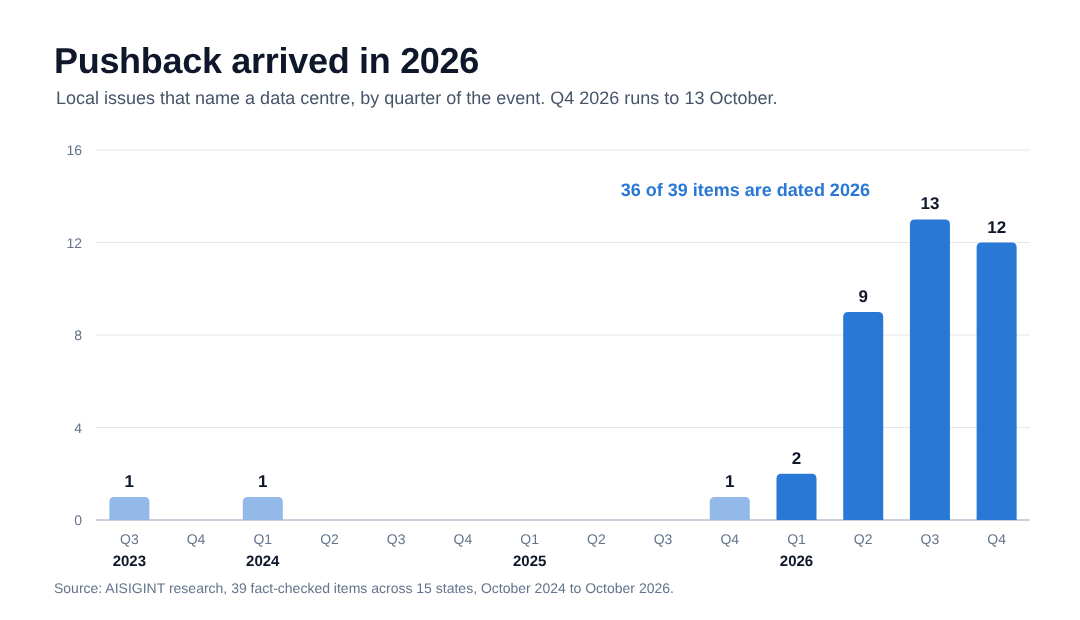
Until this year, objections to Indian data centres barely appeared in local news. 39 of the 91 items name a data centre directly, and 36 of those are dated 2026. 20 are from September and October alone.
Some of that rise reflects closer coverage of recent months. The direction is still clear. As the hyperscale projects announced in 2025 reach land notices and environmental clearances, the communities next to them are responding.
Local opposition comes in many shapes
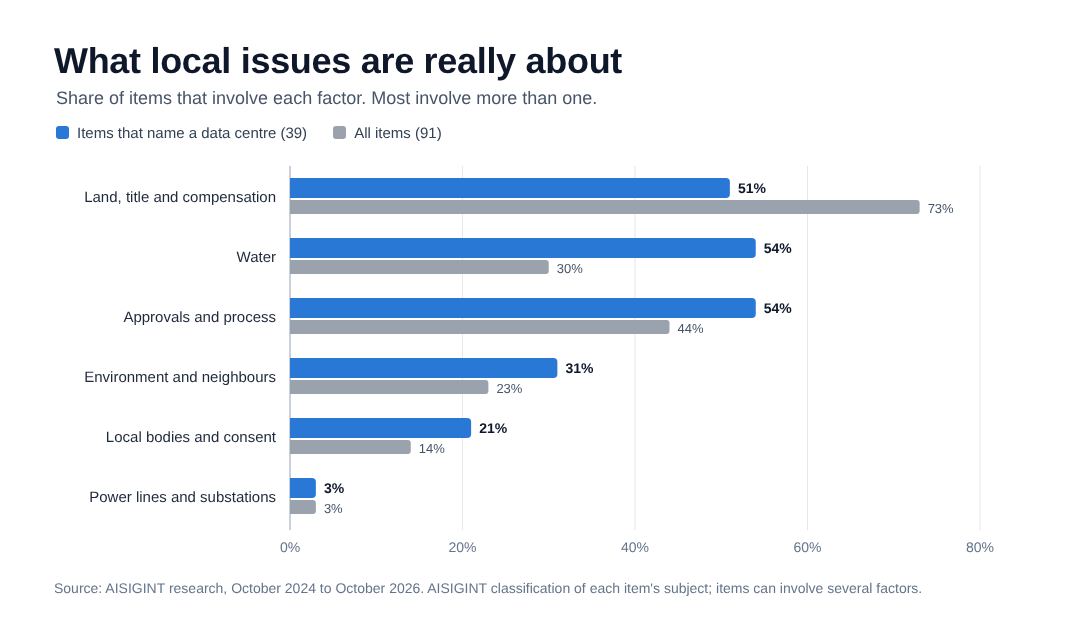
Only 6 of the 91 items are tied to an exact site. Most are recorded against a village, a town or a whole district. And 53 of the 91 (58%) involve two or more factors at once, such as a land acquisition that is also in court, or a protest that is really about water.
For items that name a data centre, the mix shifts sharply. Water and approvals each come up in 54% of them, land and title in 51%, and the environment and neighbours in 31%.
What it is about
Each factor reaches a site in a different way, and often from well beyond the site's own town.
- Water travels. The objection to an AI data centre on the Ujani dam came from farms across the command area, and the local MP wrote to 29 legislators who represent it. In Odisha, a river campaign asked the state to secure Cuttack's water before supplying the Naraj park. A site shares exposure with everyone on the same source, however far away they live.
- Land carries its history. At Tarluvada, near Visakhapatnam, the dispute is about Dalit-assigned land. At Adavivaram-Mudasarlova it is temple land, now the subject of a PIL in the High Court. Two plots side by side can carry very different risk depending on their category and title.
- Approvals are a target. Objectors in Andhra Pradesh argue that clearances granted at state level should have gone through a fuller process, and an appeal is before the National Green Tribunal. At Balkum in Thane, the local MP asked for an independent review of the permissions and a public hearing.
- Consent sits with local bodies. Ambernath's municipal council voted down a plan to sell treated sewage water to a green data centre park. Farmers at Parigi used a gram sabha to object to land for a 400 kV substation. Neither decision was made at the site.
- Neighbours matter. At Balkum, residents objected to a campus next to housing, schools and hospitals, a claimed 12 million litres of water a day, and diesel generators.
Who raises it, and how it moves
- Different people, different channels. Farmers protest and boycott gram sabhas. Councils pass resolutions. Scientists petition the environment authority. MPs write to legislators. Each route works on a different timetable, and some end up in the High Court or at the National Green Tribunal.
- It changes shape. A protest becomes a court case. A compensation award settles a dispute, and a later reset can unsettle an acquisition that looked closed. An appeal can reopen a clearance that was already granted.
- It arrives at different times. Some issues are on record before a buyer arrives. Others surface after commitment: when the line is surveyed, when water is allocated, or when an approval is challenged.
- It does not always cut one way. The record also holds supportive moves. Some Tarluvada villagers welcomed the Google data centre in the hope of jobs, and the Sri City expansion drew no reported opposition.
Why a quick search finds only part of it
- The issue often sits somewhere else. It may be at the substation the site needs, along the line route, at the reservoir, or in a court hearing a case about the industrial park.
- It rarely uses the project's name. Sources name the village, the mandal, the industrial park or the substation, not the data centre a buyer is looking at.
- Much of it is not where a search looks. Gram sabha resolutions, district land notices, tribunal orders and local-language papers rarely surface in a quick search in English.
- The record is rarely precise. Most items name a village, a town or a district rather than a parcel. Finding nothing near the site proves little, and a protest next door may be about a road that has nothing to do with it.
- Nearness still matters. An active objection next to a site is a real warning. It is simply not the only one.
Where it is concentrated
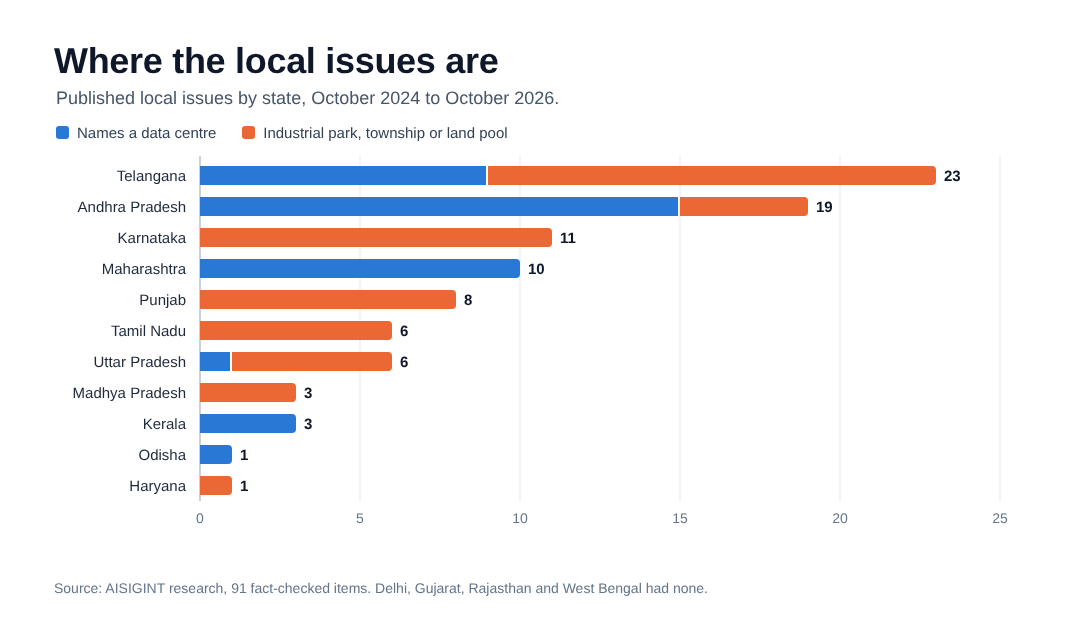
Three states account for 34 of the 39 data centre items.
Andhra Pradesh leads, almost all of it around Visakhapatnam, where the Google and Adani campuses face court cases, a tribunal appeal and an organised campaign. A new front opened in October at Bhogapuram, where farmers are resisting land notices for a Reliance data centre. Maharashtra's 10 items are all about data centres, clustered at Balkum and the Ujani dam. Telangana has the most items overall, most of them tied to the land take for Future City south of Hyderabad.
Elsewhere the fights are about land around the parks, not the data centres. That is true of Karnataka, Punjab, Tamil Nadu and Uttar Pradesh, where farmers in Noida and Greater Noida have spent years pressing the development authorities for promised plots and compensation.
Is it stopping anything? Not yet, mostly
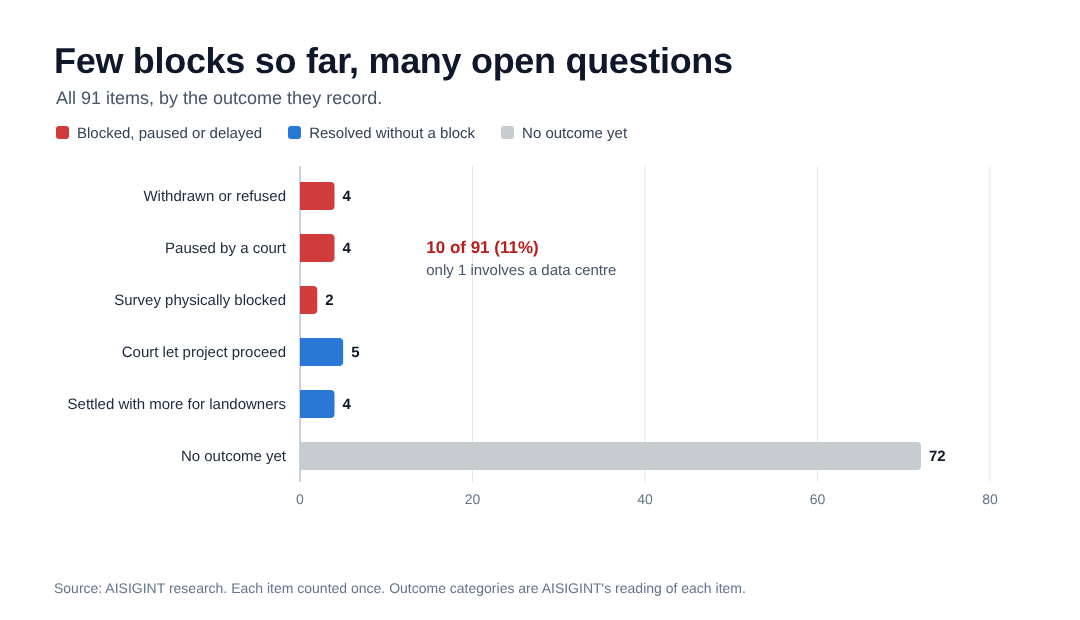
Of the 91 items, 10 (11%) record a project being blocked, paused or physically delayed.
- Four were withdrawals or refusals. Karnataka dropped a 1,777-acre aerospace park acquisition at Devanahalli. Punjab scrapped land pooling around Mohali's Aerotropolis. Tamil Nadu cancelled one notice in its Cheyyar SIPCOT expansion. Ambernath refused water to a data centre park.
- Four were court pauses. These were at Lagcherla and Pharma City in Telangana, at the Bidadi township in Karnataka, and at a 300-acre industrial park in Mohali.
- Two were land surveys that farmers physically stopped.
Only one of those ten involves a data centre directly, and it cut off a water source, not the project. When courts did rule, they sided with the project five times.
The bigger effect so far is cost and time. Karnataka raised Bidadi compensation to over ₹3 crore an acre or half the developed land. Madhya Pradesh offered a 60% developed-land return on the Indore-Pithampur corridor. Mohali's July awards for the Aerotropolis went up to ₹8.29 crore an acre. And 72 of the 91 items have no outcome yet. They are open questions that a site buyer inherits.
What this means for site feasibility
Because local issues attach to what a site depends on, they rarely arrive one at a time, and rarely where a buyer is looking. Feasibility has to treat them as part of the site itself, not as events happening nearby.
How it moves a project
- Time. Court stays and blocked surveys add months, and appeals can run longer.
- Cost. Compensation is being reset upwards, from ₹3 crore to over ₹8 crore an acre in recent awards. Gujarat has moved transmission line compensation to twice market value, which will shape the cost of any new line route.
- Design. Water strategy is now a siting question. Recycled water, lower-water cooling and distance from homes are becoming part of whether a site is acceptable, and Maharashtra's pollution board says it is drafting siting rules.
- Phasing. A clean first phase on clear land can proceed while a contested parcel or line route is resolved.
What a feasibility review should do
- Start from what the site depends on, not from the pin. List the land and its title, the water source and who else uses it, the substation and line route, the approvals the project relies on, and the local bodies whose consent or supply it needs.
- Tie each published issue to the dependency it touches. Record the source, the date and why it is linked, so the judgement is about exposure, not distance.
- Turn every active objection into a condition before commitment. A contested water source means securing a recycled or alternative supply agreement. A disputed line route means confirming the route and its right of way with the utility. A land case means confirming title, acquisition status and compensation.
- Test the plan against delay. Where a court, tribunal or compensation dispute touches the site, look at the first phase with power arriving six and twelve months later, as a sensitivity beside an unchanged base case.
- Keep it as evidence, not a verdict. A published objection is not approval or refusal, and an empty record does not prove there is no opposition. It shows which questions to ask first.
Which states will see more of this
Our read, based on what is already in the record and where the next projects are going.
Likely to see more
- Andhra Pradesh. An organised campaign, live cases in the High Court and at the NGT, sensitive land, and a second site at Bhogapuram already contested.
- Maharashtra. Water in a drought-prone state, and campuses next to housing, as at Balkum.
- Telangana. The scale of the Future City land take. Objections are spreading to power infrastructure, including a 400 kV substation at Parigi.
Worth watching
- Uttar Pradesh. Unsettled plot and compensation claims around Noida, Greater Noida and the Jewar airport, plus groundwater stress next to the data centres.
- Karnataka. The Bidadi "AI city" township faces a review committee and High Court limits. At Devanahalli the state has already backed down once.
- Punjab. A High Court stay on a Mohali industrial park, and continuing Aerotropolis protests despite record awards.
- Odisha and Kerala. A water objection at the planned Naraj park, and an inquiry into land acquisition at the KINFRA Mattannur park, where an AI data centre has signed an MoU.
Quieter so far
- Tamil Nadu. No opposition aimed at data centres. Disputes over SIPCOT parks are being settled in court and through compensation.
- Haryana and Madhya Pradesh. One groundwater case in Gurugram. Land pooling fights in Indore are turning into compensation deals.
- Gujarat, Rajasthan, Delhi and West Bengal. Two years of AISIGINT research found no local opposition to data centres. Gujarat's farmers have fought transmission lines from the Khavda renewable park hard, so any new line into Dholera or Sanand should expect the same negotiation.
How AISIGINT helps
AISIGINT collects local issue data on a regular basis across states, from local, state and national sources: gram sabha and municipal resolutions, district land notices, state pollution board hearings, High Court and NGT orders, and national clearance records, in English and local languages.
That record is read against what a specific site depends on. Each local issue is judged by what it touches, whether the land, the water source, the power route, the approvals or local consent, rather than by how far away it is. Open issues become conditions to clear before commitment, and where a court or compensation dispute is involved, their effect on timing is shown as a sensitivity alongside the base case.
The record is evidence for judgement, not a verdict, and an empty record does not prove there is no opposition. It tells a buyer what is already public, so the first site visit starts with the right questions.
*Method: 91 published local issues from AISIGINT research across Maharashtra, Telangana, Andhra Pradesh, Tamil Nadu, Karnataka, Uttar Pradesh, Delhi, Haryana, Gujarat, West Bengal, Odisha, Kerala, Rajasthan, Madhya Pradesh and Punjab, October 2024 to 13 October 2026. Sources include High Court and NGT orders, pollution control board notices, state gazettes, municipal and gram sabha resolutions, and English and local-language news. An item is one published event; one dispute can produce several. "Names a data centre" means the source ties the event to a data centre project. Factor shares are AISIGINT's classification of each item's subject, and an item can involve several factors. Outcome categories are AISIGINT's reading of each item. Duplicates, old and settled matters, statewide policy statements and disputes with no link to a data centre area are excluded, including power line disputes tied only to renewable evacuation. Recent months are covered more closely than the backlog, so read time trends as direction, not exact rates. Allegations are reported as made by the people quoted in the sources. No private individuals are named.*