Update, 19 November 2026: we have added a section on the regulator's new rule for direct national grid connections, which does not change the model results, and a section on how we can help.
More and more of the developers, lenders and tenants we speak to in India are asking the same question. It is less about how many megawatts a site needs and more about when the grid will actually deliver them.
We went looking for the answer in the Mumbai region, India's largest datacenter market. We went through the construction record of Indian grid works, followed the route power takes to reach a site, and built a model of the region to 2030. Most of the power Mumbai's datacenters want by 2030 looks set to arrive late, and even a magic wand would not fix all of it.
Why the date matters
A datacenter without a grid connection earns nothing, and in India the developer absorbs that cost. Indian rules do compensate consumers for a late connection, but the amounts are token. Maharashtra's rules set it at Rs 100 per week of delay or less, and those rules were written for homes and shops. Rent tells a different story. Cushman & Wakefield put Mumbai rents for deals above 5 MW at Rs 6,000 to 7,500 per kW per month in the first half of 2025. A fully let campus with 100 MW of IT load, meaning the power used by the computers themselves, therefore loses about Rs 60 to 75 crore of rent a month, or about $6-8M. That is Rs 2 to 2.5 crore for every day it waits.
Tenants are under no obligation to wait. In October 2026 Microsoft pulled out of Nscale's planned 50 MW AI datacenter at Loughton, Essex, in the UK, after warnings that the grid capacity it needed might not be available until the 2030s. Lenders are charging more as well. Oracle bonds issued at 6.7% in February were trading at about 8.3% by early November, and CoreWeave's unsecured bonds traded near 15% in October. When capital is this selective, it goes first to the projects that can show a credible power date.
Indian grid works usually run late
How credible are Indian power dates? We follow every transmission work at 220 kV, 400 kV and 765 kV across India in the national construction reports since 2017. Kilovolts (kV) measure voltage, and the higher the number, the larger the line or substation. That gives us more than 8,000 records, and about 3,500 of them carry both a planned date and an actual or expected one. A typical work is commissioned about 11 months after its first schedule. The works datacenters depend on are mostly built by state utilities, and the chart shows that those run later.
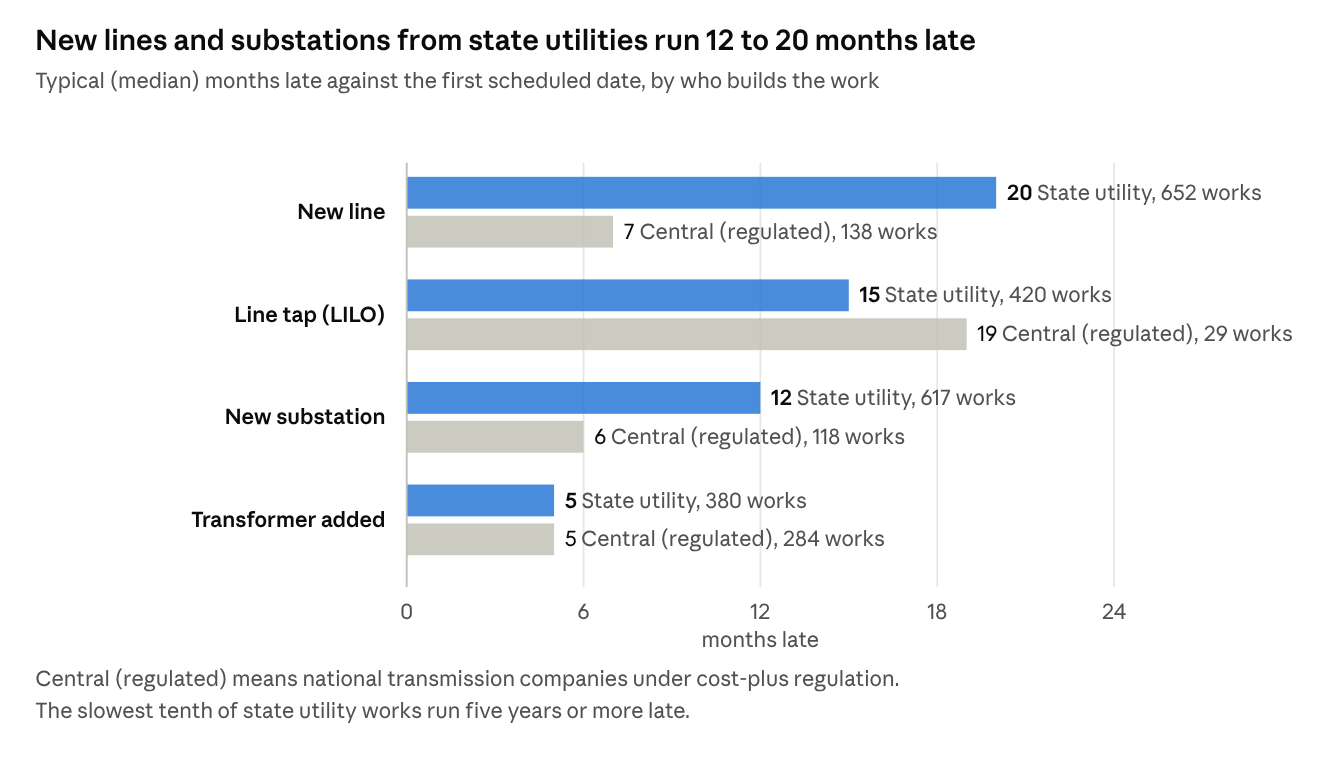
Mumbai shows what that looks like on the ground. The 400 kV Babhaleshwar-Kudus line into the city was only commissioned in April 2026, after years of delay. The replacement 400 kV substation at Kalwa was due in FY2025-26, but bids only closed in September 2026, and on our estimate it is more likely to arrive in 2029 to 2031.
These delays would matter less if the load were spread out, but it is concentrating where the grid is tightest. Mumbai city depends on power brought in from outside, and the state grid operator raised that import limit to about 3,200 MW in August 2025, after new 400 kV lines from Padghe came into service. When circuits tripped in July and August 2025, the grid operator had to cut the limit it was working to from 2,220 MW to 1,690 MW while they were out. A new 1,000 MW link came into service in April 2026, which shows how much each new link matters and how long the city waits for one.
How power reaches a datacenter
When we say that power is late, we mean that something on the route to the site is not ready. Power has to clear every point below, and the slowest one sets the date.
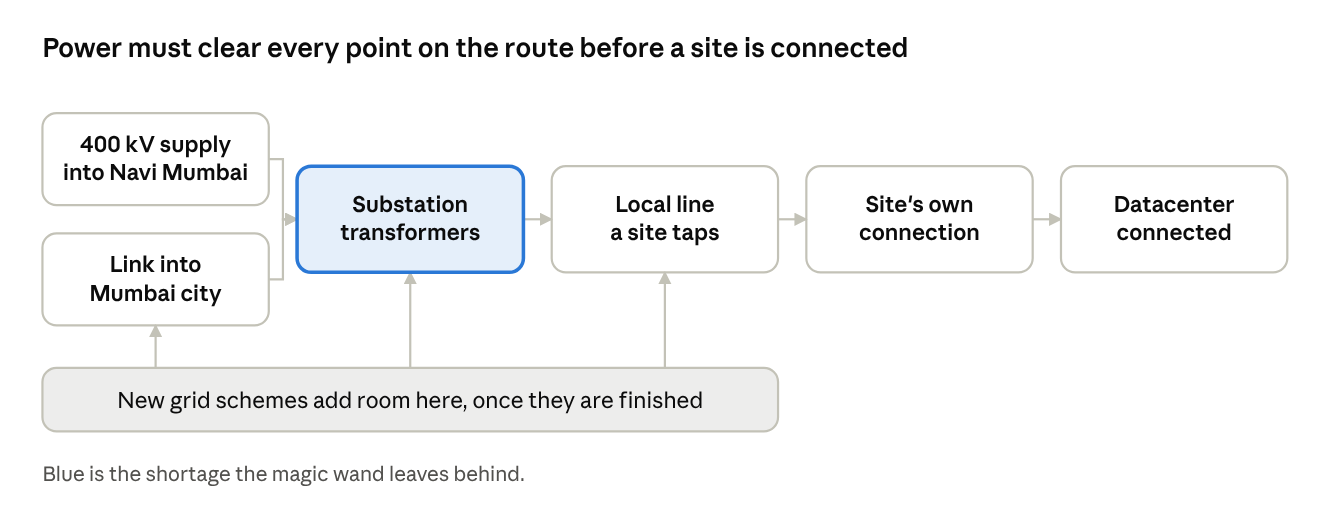
The route starts with the big supply into the area. Sites around Navi Mumbai and Thane draw on a handful of 400 kV yards, such as Kalwa, Kharghar and Padghe, and those yards can only take so much more load from the wider grid. No utility publishes how much. We estimate room for about 700 MW of new datacenter load, and it could be as little as 300 MW or as much as 1,200 MW. Sites supplied by Mumbai city's own distribution companies pass through a different gate, the import limit into the city. The largest new loads are now being sent around these yards. The national grid planner refused Adani a new tap on the Padghe to Kharghar line, because the equipment at Padghe and Navi Mumbai could not safely handle the extra fault current. Instead the Ghansoli datacenter, with 1,518 MW, and Adani's Navi Mumbai projects, with 500 MW, will connect at a new 765 kV yard at South Kalamb, due in January 2028.
Next comes the local substation, where transformers step power down to a lower voltage. This is where most sites get stuck, and when we say a substation has no room we mean electrical capacity rather than floor space. Utilities plan so that the peak load can still be carried if the largest transformer fails. Take a substation with three transformers of 500 MVA each, a rating close to megawatts. With one out, the other two can carry about 950 MW. If the local peak is already 900 MW, only about 50 MW is left, and a 100 MW datacenter has to wait for another transformer or a new substation. In practice substations can run somewhat above this limit for a while, and our model allows for that. Kalwa already fails this test. The state transmission company says its 2,100 MVA of transformers have carried about 1,900 MVA, and that the others could not cope if one 600 MVA unit failed.
From the substation, power travels along a 220 kV or 100 kV line. Many developers tap an existing line, which the industry calls a loop-in loop-out or LILO. Of the 36 datacenter projects in the state grid operator's December 2025 study, 27 connect this way, all of them in the Mumbai region. The tap itself is short, and in Maharashtra the customer builds it, but it does not avoid the wait for everything upstream. Datacenters connecting by a 220 kV tap had received only about 37% of the power due to them by the end of 2025, no better than those connecting at a substation.
The last step is the site's own connection. Utility approval takes about 4 to 15 months, and building a 220 kV line tap takes about 15 to 36 months.
Utilities add room along this route through grid schemes, meaning the new substations, transformers and lines they have planned. We count 27 of them in the Mumbai region, and each has a target date that can slip.
What this means by 2030
Datacenter projects in the Mumbai region want about 6.2 GW of new grid power by the end of 2030, on top of what is already connected. That is our middle estimate from announced and approved projects, sized at the grid connection including cooling. It is most likely between 4.4 GW and 9.3 GW.
Our Mumbai corridor model sets that demand against the capacity due at each substation, month by month. We tested it on history first. Started from mid-2022, it lands within its stated range of the 526 MW of datacenter connections actually made in the Mumbai region by December 2025. We set one assumption, how far substations can run above their safe planning limit, to fit that history, so this is one check and not proof. History also cannot yet test the 400 kV supply that drives much of the result.
The chart starts with our base case and then removes the problems one at a time, so each bar shows what is left.
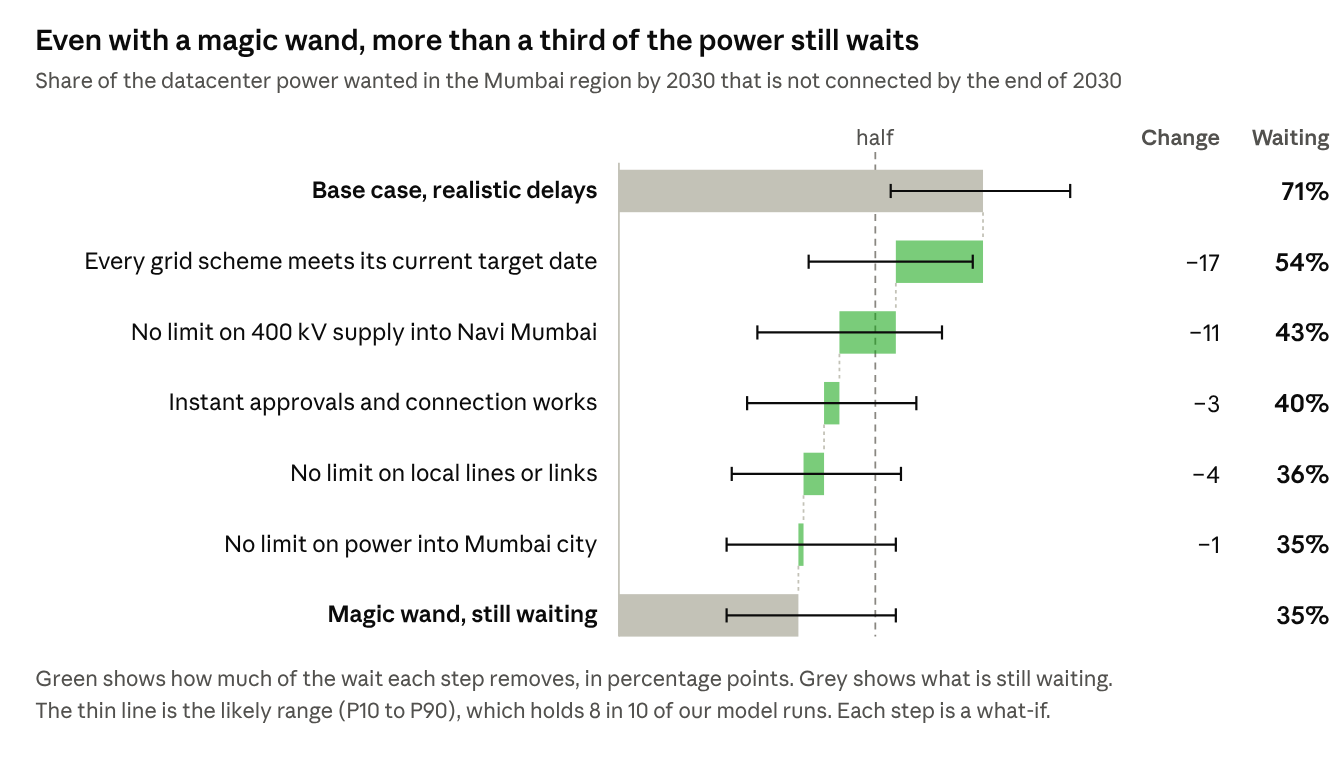
The top bar is the base case, where grid schemes run late at the pace we expect. About 71% of the 6.2 GW, or about 4.4 GW, is still not connected at the end of 2030.
The second bar assumes every grid scheme finishes on its current target date and none is cancelled. That is the date on paper today rather than the first one promised, so Kalwa arrives in March 2029 in this case. Even then 54% is still waiting. Some targets are simply too late, such as the new 400 kV substation at Chandivali, due in FY2030-31, and finishing on time does not remove the other limits.
The third bar also removes the limit on the 400 kV supply into Navi Mumbai, which leaves 43% waiting. This step rests on our own estimate of that limit. If the room is 1,200 MW rather than 700 MW, the base case falls from 71% to 66%, and at 300 MW it rises to 77%. The size of each step also depends on the order. Removing the 400 kV limit first would take out about 22 points rather than 11.
The last three steps are the magic wand. Approvals and connection works become instant, local lines and the links between substations can carry any load, and any amount of power can flow into Mumbai city. The share still waiting only falls to about 35%, or about 2.2 GW. Faster paperwork and construction barely help, because when a site is ready the substation still has no room for it.
What is left is a shortage rather than a delay, and it is a last-mile problem. Think of the grid as a road network. The magic wand opens every highway and power can flood towards the city, but the internal roads into each neighbourhood, which are the substation transformers, are already choked. All of the remaining 2.2 GW is waiting for transformer room, most of it at Kalwa and Kharghar. The substations planned for 2030 do not have the room for this power, and on our model only new projects that are not yet on anyone's books can provide it. Each late megawatt is counted only once.
The state's own figures point the same way. In November 2026 the Maharashtra Energy Department put the grid connection need of about 15 Navi Mumbai datacenters at 4,000-5,000 MW, against 1,500-2,000 MW sanctioned, as Business India reported. That leaves roughly 2,000 to 3,500 MW unsanctioned. The state's answer is a new 765 kV substation, to be built through a separate project company on 25 acres sought from MIDC. That request has gone unanswered for about 18 months, and the Additional Chief Secretary (Energy) puts the build at three to five years. Even if the land were handed over this month, the substation would arrive between late 2029 and late 2031.
A new national route does not create substation room
On 11 November 2026 the national regulator, CERC, made final the Fourth Amendment to its connectivity and General Network Access rules, Regulation No. 209. A campus already drawing power from a state network can now connect directly to the interstate grid for part of its load, at 50 MW or more, or for all of it. It needs consent from the state transmission utility and the distribution company, and the rule sets no deadline for that consent. The state charges stay on both connections.
The new route changes who a campus can connect to. It does not change when there is room for it. A direct interstate connection still has to land at a substation with transformer room, and around Mumbai the interstate options are Padghe and Navi Mumbai, where the national planner has already refused a new tap because of fault current, or the new South Kalamb 765 kV yard due in January 2028. Our model already lets any amount of power flow into the region in its magic wand case, and 2.2 GW still waits for transformer room. One part of the rule does matter to investors. Once a campus's grid access is in effect, it now moves with the load to a buyer, so a campus that holds it carries that access into a sale.
How we built these numbers
Every input is sourced and dated, and where no utility figure exists we say it is our own estimate. Utilities do not systematically publish the spare capacity at each substation or the 400 kV headroom into Navi Mumbai, so we estimate them from published utility and regulatory documents. Our coverage is all of India and deliberately goes above 220 kV. We map about 160 substations at 765 kV, about 870 at 400 kV and about 3,300 at 220 kV, and for about 1,500 of them we hold the installed transformer capacity. The 400 kV and 765 kV stations matter most, because most 220 kV substations a datacenter connects to are fed from them, and a full 400 kV yard upstream can hold up a site that looks fine locally. We also track every peak load a utility has published for these substations, and 46 datacenter projects in the Mumbai region by stage and target date. Infrastructure professionals with site selection and grid connection experience review the grid evidence.
What this means for capital
Public coverage of Indian datacenters has so far focused on how much power they will use. In July 2026 the Power Ministry told Parliament that AI datacenters could add 26.3 GW of load by 2031-32, nearly double its earlier projection for all datacenters. Those numbers are useful, but we have not found a published answer to when that power will arrive or who carries the cost while they wait.
For developers, investors and lenders, the date a site gets power now matters as much as the lease. Announced MW is not the same as delivery-ready MW, and the gap between the two is where projects lose money. The questions that close that gap are specific. Which substation will serve the site, how much spare capacity does it have, which scheme closes the shortfall, and how late is that scheme likely to run?
That is what we built AISIGINT to answer, site by site across India at 220 kV, 400 kV and 765 kV, with a dated verdict, the evidence behind it, and a record of how the dates move after capital commits.
How we can help
We do this work for developers, operators, investors, lenders, landowners and their advisers, on four kinds of brief.
- A site you hold or are buying. A GridFit Screen sets out the grid connection options for a named site, usually within one working day: the substations in reach, any published loading, the works they depend on and when power is likely. Several sites can be compared side by side.
- A site you are about to commit capital to. An Audit takes the site through power, land, approvals, water, fibre and the commercial case, and ends in a GO, CAUTION or NO-GO verdict with the gates to close first. Field diligence, such as surveys and soil testing, can be added through our partners.
- A requirement with no site yet. For an RFP or a campus requirement from 100 MW to 2 GW, a campus search ranks the corridors and representative sites on power by phase, land, water, fibre and local issues, and answers the requirement line by line.
- Land you want to bring to investors. A site pack shows what a parcel can support: the power route and date, the campus it could hold, and why it would suit a hyperscale or AI tenant.
Every report is reviewed by our datacenter site team before release.
Sources
- MERC Standards of Performance for distribution licensees, compensation for delayed connection
- Microsoft pulls out of delayed Nscale data center in Loughton, Essex, Data Center Dynamics, October 2026, and The Register, October 2026
- AISIGINT grid database, September 2026, compiled from public utility and regulatory documents
- Bond investors have cooled to AI debt. Big Tech doesn't care, Axios, November 2026
- CoreWeave's market confidence erodes as bond yields spike and stock sinks, CNBC, October 2026
- India Data Centre Update, H1 2025, Cushman & Wakefield
- AI data centres to add 26.3 GW to India's power demand by FY32: Govt, Business Standard, July 2026
- AISIGINT Mumbai corridor model, run November 2026, back-tested against the 2022 to 2025 record
- MSLDC Annual Operations and Performance Report 2025, Mumbai import limit, 2026
- CTUIL minutes of the 42nd Western Region CMETS meeting, February 2026, and of the 46th meeting, August 2026
- MSETCL minutes of the 12th Maharashtra Transmission Committee, January 2025
- MSLDC study of datacenter load in Maharashtra, December 2025
- CERC Connectivity and General Network Access to the inter-State Transmission System (Fourth Amendment) Regulations, Regulation No. 209, November 2026
- Maharashtra's data centre ambitions face power infrastructure bottlenecks, Business India, November 2026
- CEA progress reports on transmission lines and substations at 220 kV and above, quarterly and monthly, 2017 to September 2026